In the quiet villages surrounding Sri Sathya Sai Vaatsalyam, a subtle transformation is unfolding.
For many of the village children, opportunities to engage with India’s classical art traditions were once distant—something seen, perhaps admired, but rarely experienced firsthand. Today, that distance is slowly dissolving. Through Nritya Maadhuryam, Bharatanatyam is no longer just an art form they observe—it is becoming a language they live.
From First Steps to Finding Their Voice
What began with a small group of children stepping hesitantly into their first dance class has, over time, grown into a vibrant learning space. Nearly three years into this journey, around 30 children from nearby villages now come together regularly—learning, practicing, and gradually discovering their own voice through movement.
For these young learners, dance is no longer about remembering steps. It is about expression. It is about confidence. It is about discovering that they, too, can create something beautiful.

Nritya Sadhana was conceptualised as a medium to bring the art that lives within each student to the forefront, while gently marking their progress through meaningful and reflective examinations. It is not designed as a test of performance but as a process that honours effort, understanding, and inner growth.
Each Nritya Sadhana examination is viewed as an extension of practice itself—a milestone shaped by the many dedicated hours the student has invested over time. The emphasis is placed firmly on the journey rather than the exam, recognising consistency, sincerity, and receptivity to learning.
Students are selected to appear for the examination based on their demonstrated dedication in class—how they engage with the shared knowledge, apply corrections, and grow steadily in both understanding and expression. Thus, the examination foregrounds the meaning of sadhana, recognising and honouring the learner’s natural progression.
The certificates and report cards they receive serve not merely as acknowledgements of completion, but as reflections of their journey—documenting effort, learning, and areas of growth, while encouraging mindful practice and continued exploration of the art.
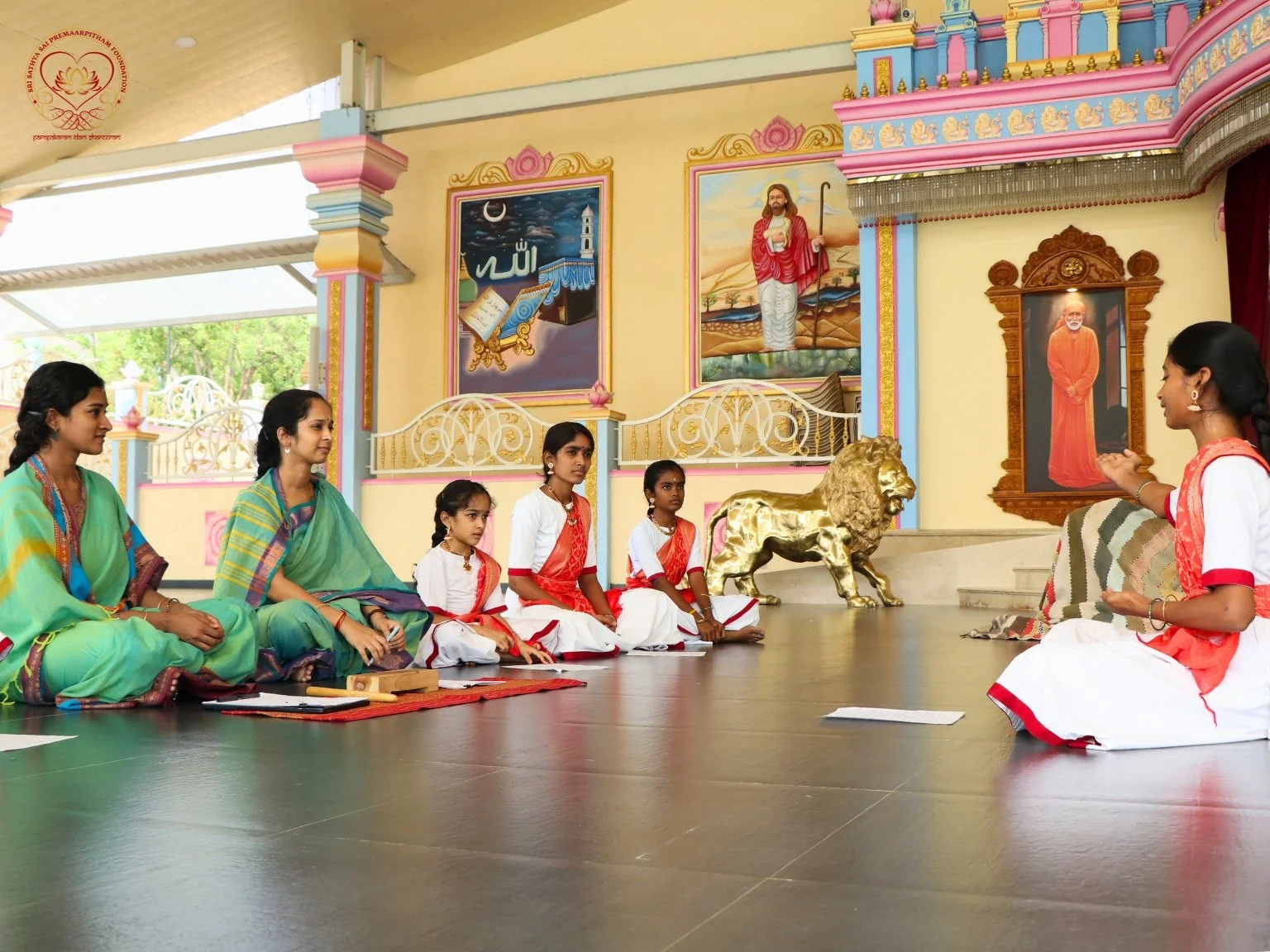
The recently-held Nritya Sadhana 3 offered a window into this quiet blossoming—marking an important point in the journey of students who have been learning and growing in the programme for over two and a half years.
Seven students, who have journeyed through this programme with dedication, stepped forward to demonstrate not just what they had learnt—but who they were becoming.

There was a time when rhythm had to be counted carefully, when movements were imitated with hesitation, and when expression felt unfamiliar. Today, those same children approach dance with a growing sense of ease. Their feet move with greater certainty, their understanding of talam has deepened, and their bodies carry a natural grace shaped through consistent practice.
Beyond Steps: Discovering Expression and Meaning
During the examination, they were challenged in new ways—introduced to unfamiliar adavu combinations, asked to sustain their practice with stamina, and guided to explore rhythm through sollukattus. What stood out was not perfection, but presence—their ability to listen, adapt, and respond with attentiveness.


Their sense of rhythm showed growing maturity as they engaged with sollukattus across varying speeds, reflecting increasing confidence and control. The geethams they have learnt brought together movement, expression, and musicality, revealing how different aspects of their learning are beginning to integrate.


Together, these elements offered a holistic view of their progress—not just in technique, but in understanding and expression.
Perhaps the most beautiful shift could be seen in their first steps into abhinaya.
As they explored the navarasas, something within them opened up. The transition from movement to meaning became visible. A smile was no longer just performed—it was felt. A gesture carried intention. Expression began to emerge not from instruction, but from understanding.
“When I first started, my focus was mainly on getting the steps right. Now, it is about understanding the dance as a whole. This deeper understanding helps me dance with awareness—whether it is abhinaya, keeping tala, or expressing the lyrics—and has allowed me to connect more meaningfully with the dance.”
— Lavanya N, Student, Nritya Maadhuryam
Alongside performance, the children also engaged with their learning in thoughtful ways. Through charts, drawings, and explanations on hastas, adavus, and bhedas, they reflected on what they had absorbed. These were not just assignments—they were expressions of ownership, showing that learning had moved beyond the classroom into their own thinking.


A special feature of the exam was the impromptu storytelling activity, where each child individually created a story on the spot. Within their narratives, they thoughtfully incorporated the hastas, bhedas, and navarasas they had learnt, making the experience both engaging and meaningful, while revealing the depth of their learning in a joyful way.


“My favourite part of the exam was the storytelling, as it gave me the chance to think of a new story, share it, and also learn from others’ interesting ideas. It made the exam enjoyable and easy.”
– Siya Bhat, Student, Nritya Maadhuryam
Confidence Taking Root
Yet, what made this Nritya Sadhana truly special was not what they did, but how they did it.
There was nervousness, yes—but it was gently held by enthusiasm. There was effort—but it was accompanied by joy. Each child stepped forward with sincerity, revealing a quiet confidence that has been steadily taking root over time.
“Before joining the dance classes, I never imagined that I would learn Bharatanatyam at Sri Sathya Sai Vaatsalyam. With Bhagawan’s grace, I joined, and it has truly changed my life. I feel very happy to learn and dance, and I am slowly understanding what practice truly means and how to practise well.”
— Gagana S, Student, Nritya Maadhuryam
For children growing up in socially and economically challenging circumstances, this journey carries a deeper meaning. Within this space, they are not defined by limitation. They are seen for their effort, encouraged for their potential, and supported in discovering their own capabilities.


“It is deeply rewarding to see the children apply what they have learned in class and respond confidently during the examinations. Their progress inspires us to become better teachers and encourages us to explore newer and more interesting ways of teaching, so we can support and reach every child more meaningfully.”
— Sourabha, Acharya, Nritya Maadhuryam
Dance, here, becomes more than an art form. It becomes a doorway—into confidence, into discipline, into self-belief.
Growing Together, Moving Forward
And the journey continues to grow.
Just weeks ago, a new batch of 15 children from Uyyamballi and Bendegodu joined Nritya Maadhuryam. With both boys and girls stepping in with curiosity and excitement, the space is expanding—carrying forward the message that classical dance belongs to everyone.


As the older students move ahead with stronger foundations, and the younger ones take their first steps, Nritya Maadhuryam stands as a living, growing ecosystem of learning.
Guided by devoted Acharyas and anchored in values, this initiative is shaping more than dancers. It is nurturing individuals who carry within them a sense of discipline, awareness, and cultural connection.
And in each small village child who now stands a little taller, moves a little freer, and smiles a little brighter—we see the true rhythm of this journey.